Commercial glass / Project guidance
Commercial door closer repair
A slamming, drifting or slow-closing entrance can disrupt daily access. Request an assessment of the closer, arm, mounting and door movement before choosing adjustment or replacement.
Request a quoteService suitability, location coverage and scheduling must be confirmed for your project.
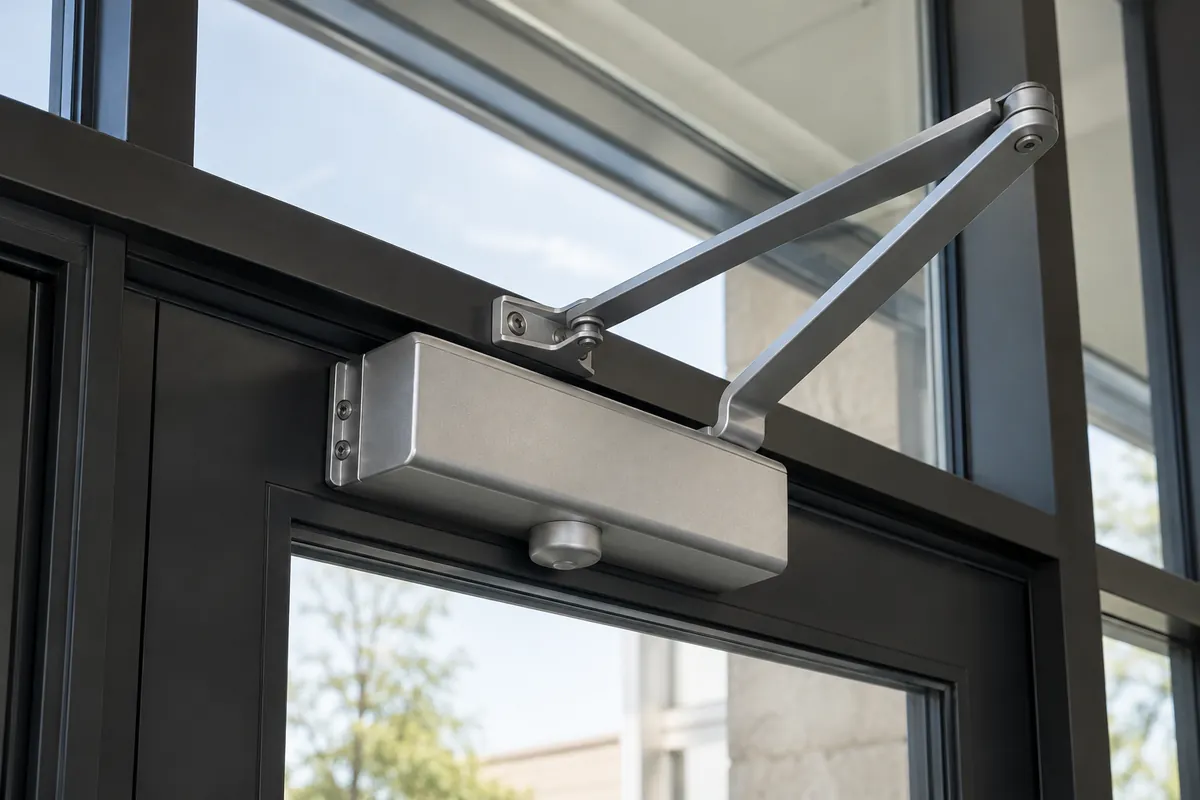
Identify when the problem occurs
Describe whether the door slams throughout its travel, stalls near the latch or behaves differently in windy weather. Leaking fluid, loose fixings and damaged arms are useful observations to report. The door leaf, hinges, seals and latch also affect closing; changing a closer does not necessarily resolve binding elsewhere in the entrance.
Match the complete entrance
Replacement selection considers door size and weight, opening direction, mounting pattern and traffic. Existing hold-open arrangements and access requirements need review. Send model photographs from a safe standing position and identify who controls the entrance. Do not alter a closer on a fire-rated or controlled entrance without an appropriate assessment.
About this service
Questions before
the next step.
Can the closer be adjusted instead of replaced?
Sometimes. Adjustment is considered only after checking the mechanism, fixings and door movement. A leaking or damaged unit may require replacement.
Does this include automatic door operators?
Powered operators are a separate scope. Identify any automatic opener or access-control connection so the appropriate work can be assessed.
Commercial door closer repair across Canada.
Explore regional guidance and request this service in your city or surrounding community.
- Toronto
- Mississauga
- Hamilton
- Ottawa
- Kitchener–Waterloo
- London
- Windsor
- Niagara Region
- Oshawa & Durham Region
- Barrie
- Kingston
- Greater Sudbury
- Thunder Bay
- Vancouver & Metro Vancouver
- Victoria
- Kelowna & Okanagan
- Abbotsford & Fraser Valley
- Calgary
- Edmonton
- Winnipeg
- Saskatoon
- Regina
- Montréal
- Quebec City
- Gatineau
- Sherbrooke
- Trois-Rivières
- Saguenay
- Halifax
- Moncton
- Fredericton
- Saint John
- St. John’s
- Charlottetown
- Whitehorse
- Yellowknife
- Iqaluit
A clearer next step
Let’s talk through the next step.
Share your location, glass type and project details.